---
title: Falling Lab Grown Diamond Prices
description: Lab-grown diamond prices are falling fast. Understand the real causes, market consequences, and why price divergence is accelerating.
image: https://blog.facetsingapore.com/hubfs/Lab-Diamond-Prices-1024x576.jpg
---
*Start your journey with us today:* [Book an appointment](https://facetsingapore.com/appointments)
- [Diamonds](https://facetsingapore.com/diamonds)
- [About Us](https://facetsingapore.com/about)
- [Reviews](https://facetsingapore.com/reviews)
- [](https://facetsingapore.com)
- [Services](https://facetsingapore.com/services)
- [Trade](https://facetsingapore.com/trade)
- [LEARN](https://blog.facetsingapore.com/)
[](https://facetsingapore.com)
Ready to start your journey ?
- *About*
- [Facets Singapore](https://facetsingapore.com/about)
- [Customer Reviews](https://facetsingapore.com/reviews)
- [Blogs](https://blog.facetsingapore.com)
- [Gallery](https://facetsingapore.com/services/bespoke-jewellery-design#gallery)
- [Industry Insights](https://go.facetsingapore.com/diamond-industry)
- *Diamonds*
- [Why Buy From Us?](https://facetsingapore.com/diamonds#why-buy-from-us)
- [Diamond Expertise](https://facetsingapore.com/diamonds)
- [Explore Selection](https://facetsingapore.com/diamonds)
- [Natural Diamond Guide](https://go.facetsingapore.com/natural-diamonds)
- [General Enquiries](https://facetsingapore.com/contact)
- *Personal Services*
- [Bespoke Jewellery](https://facetsingapore.com/services/bespoke-jewellery-design)
- [Jewellery Resetting](https://facetsingapore.com/services/gem-jewellery-resetting)
- [Brokerage & Investment](https://facetsingapore.com/services/diamond-brokerage-services)
- [Engagement Ring Guide](https://go.facetsingapore.com/diamond-engagement-rings)
- [Bespoke Enquiries](https://facetsingapore.com/contact-bespoke)
- *Trade Services*
- [Craftsmen & Designers](https://facetsingapore.com/trade/craftsmen-designers)
- [Dealer Services](https://facetsingapore.com/trade/dealer-services)
- [Jewellery Manufacturers](https://facetsingapore.com/trade/jewellery-manufacturers)
- [Jewellery Retailers](https://facetsingapore.com/trade/retailers)
- [Trade Enquiries](https://facetsingapore.com/contact-trade)
- *Support*
- [Book an Appointment](https://facetsingapore.com/appointments)
- [Locate Us](https://facetsingapore.com/locate-us)
- [Ring Size Guide](https://facetsingapore.com/content/ring_size_guide.pdf)
- [FAQ](https://facetsingapore.com/faq)
- -
-
-
-

### 1 Min Read Time
*Photo Courtesy: Pricescope.com*
[.svg)](http://www.facebook.com/share.php?u=https://blog.facetsingapore.com/lab-grown-diamond-price-decline)
[](https://twitter.com/intent/tweet?original_referer=https://blog.facetsingapore.com/lab-grown-diamond-price-decline&url=https://blog.facetsingapore.com/lab-grown-diamond-price-decline&source=tweetbutton&text=)
[.svg)](http://www.linkedin.com/shareArticle?mini=true&url=https://blog.facetsingapore.com/lab-grown-diamond-price-decline)
[](http://www.instagram.com/shareArticle?mini=true&url=https://blog.facetsingapore.com/lab-grown-diamond-price-decline)
January 17, 2026 Suresh Hathiramani Diamond Education Did you know? Industry Insights
# Lab Grown Diamond Price Decline: Cause and Effects
Falling Lab Grown Diamond Prices
10:54
## An industry insider's analysis of how the market is evolving
### ***Why Lab-Grown Diamond Prices Are Falling - and What the Market Is Really Telling Us***
The observations shared here are not intended to challenge personal preferences or purchasing choices. They are drawn from several decades of the author's experience, observing pricing cycles in the diamond industry. *It is not an argument for one product over another, but an attempt to factually describe the state of the market currently.*
After several years of rapid growth and consumer enthusiasm, lab-grown diamond prices have declined sharply. The primary cause is quite straightforward: **production capacity expanded much faster than retail demand**, transforming what was widely positioned as a viable alternative to natural diamonds into a largely commoditised product. This correction reflects the early consequences of unconstrained supply growth rather than a consumer-led rejection of the product.
Alongside this price decline, **consumer confidence in lab-grown diamonds is beginning to waver**, creating challenges not only for rough growers and retailers, but also indirectly affecting sentiment around natural diamonds.
Since 2018, wholesale prices for popular lab-grown sizes have fallen by as much as **90–95%**, while the retail price gap between lab-grown and natural diamonds has widened dramatically - from roughly **20–30% a decade ago to 80–90% today**.
## The Rise of Lab Grown Diamonds
When lab-grown diamonds entered mainstream retail in the mid-2010s, they gained quick traction, particularly in the bridal segment. Marketed as *“the same product, only 20–30% cheaper”*, they resonated strongly with consumers - and for a time, the narrative made sense.
As long as the price difference between the two remained rational and defensible, claims of product similarity had traction. Sales of lab grown diamonds grew rapidly, often at the expense of natural diamonds. Retailers in the US and elsewhere enjoyed exceptional margins, while chemical vapour deposition (CVD) and high pressure high temperature (HPHT) producers expanded capacity aggressively. For the retailers and producer groups, the opportunity appeared compelling and exceptionally attractive.
A pivotal moment came in 2018, when the US Federal Trade Commission (FTC) ruled that man-made diamonds must be described using qualifiers such as *“lab-grown”* or *“lab-created”* to distinguish them from natural diamonds. While intended as a disclosure measure, the ruling was interpreted by many as legitimising lab-grown diamonds, not as a distinct category but rather as a direct substitute for natural diamonds.
Marketing efforts quickly capitalised on this interpretation. The natural diamond industry, by contrast, was slow to respond, losing valuable time as lab-grown production scaled rapidly and quality of the finished product improved. Prices soon followed – tracing a logical downward trajectory and technology became ubiquitous and venture capital readily flowed in.
> Since 2018, wholesale prices for popular lab-grown sizes have fallen by as much as 90–95%
## Years of Growth - and Excess
Between 2020 and 2023, production efficiency improved sharply, particularly in China and India, leading to several-fold increases in lab-grown rough output. Encouraged by early success, numerous jewellery startups entered the market, alongside established retailers who were in it only to enjoy the unusually high margins.
Younger consumers were drawn by messaging around sustainability, traceability, and accessibility. For many, previously unattainable diamond jewellery suddenly became affordable. For many young couples, proposal ring purchases were influenced more by perceived value rather than driven by sentiment. The rapid pace of declining prices undermined confidence. Consumers began noticing that diamonds purchased - or viewed in retailer’s windows just weeks earlier were being rapidly marked down.
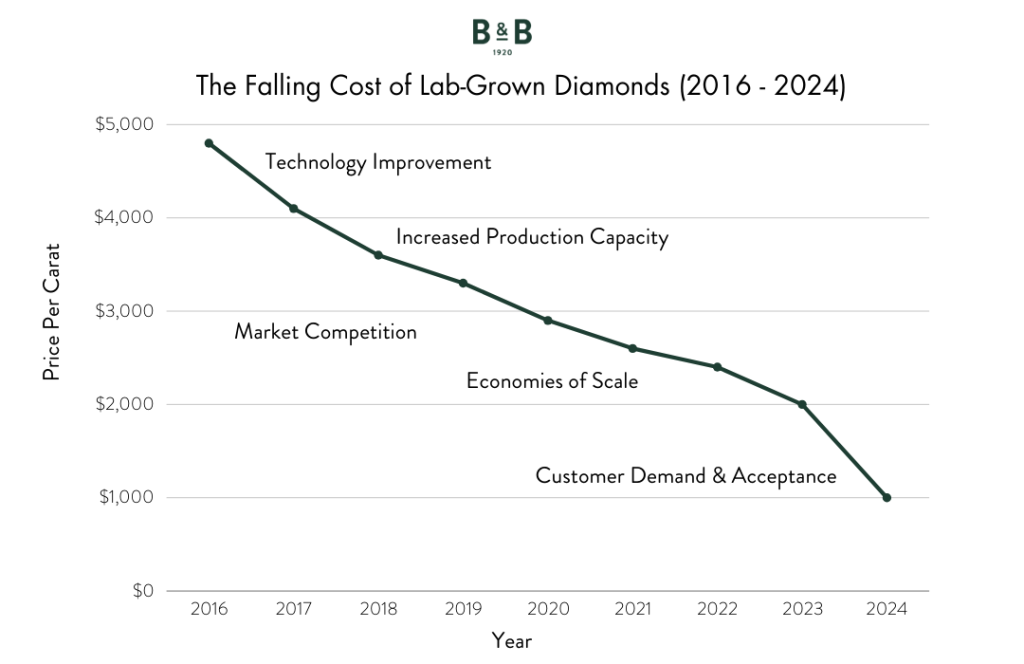
Lab grown diamond wholesale Price Trend 2016-2024. Source B & B
What initially looked like a retail windfall evolved into **intense price competition**. With little product differentiation, price became the primary lever. Predictably, the market entered a race to the bottom or what is better known in trade terms as 'margin squeeze'.
## Impact on Natural Diamonds
During this period, natural diamonds experienced price declines of up to **30–40% in certain categories from their 2022 peaks**, unsettling long-standing consumer assumptions around value retention and legacy.
This had broader implications for the entire jewellery ecosystem. Even staunch advocates of lab-grown diamonds recognised that their product’s appeal was closely tied to the historical prestige, rarity, and emotional weight of natural diamonds. As lab-grown prices fell rapidly, that effect recoiled back onto the entire brand, raising uncomfortable questions about its permanence and value.
Consumers increasingly realised that lab-grown diamonds offer **little to no resale value**, behaving more like depreciating consumer goods than enduring luxury items. This realisation affected purchasing decisions, particularly for emotionally symbolic items such as engagement rings.
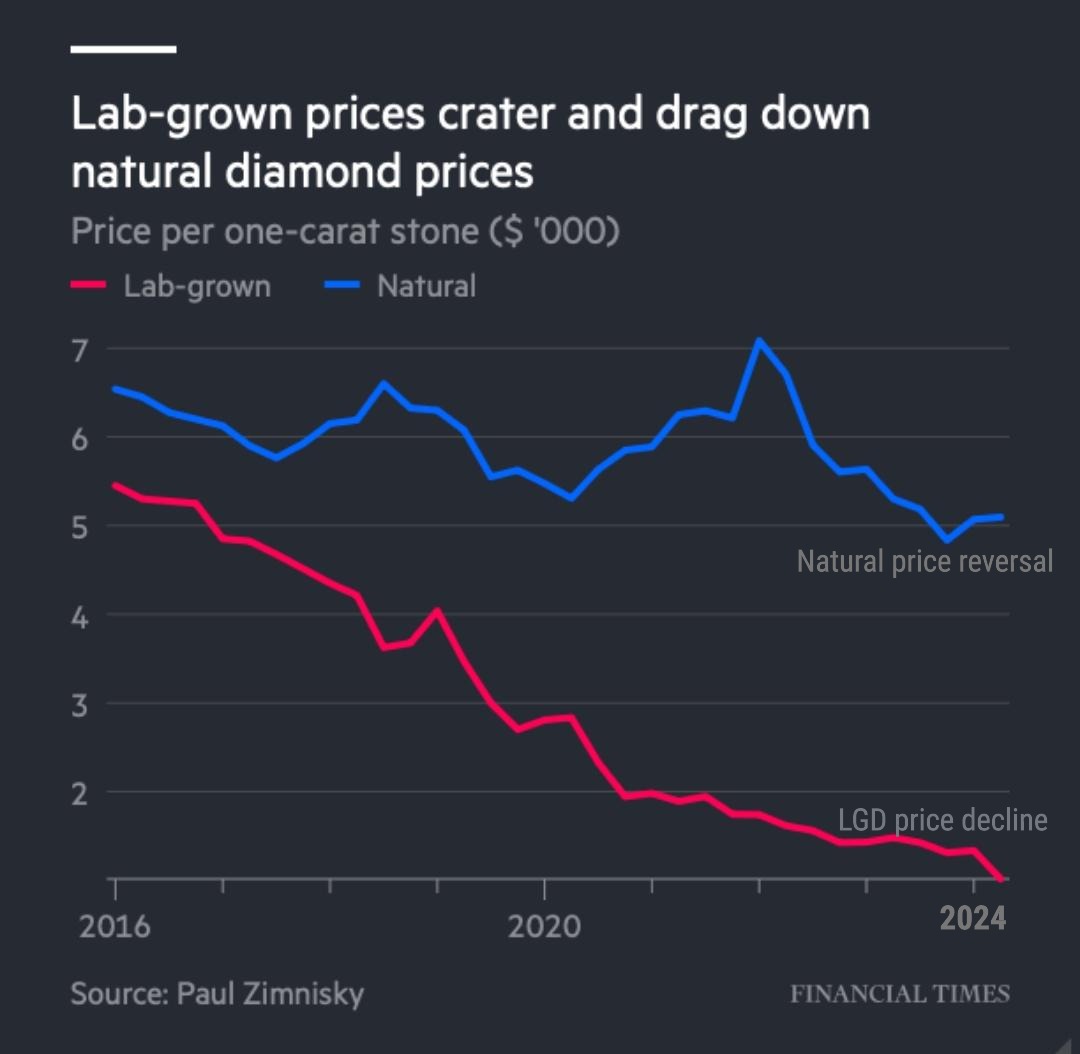
Lab Grown vs Natural diamond Price Divergence 2016-2024 - Graph Courtesy: Paul Zimnisky / Financial Times
## Intensifying Competition
The growing number of growers, polishers, and online retailers - particularly in India and China - has intensified competition. With limited scope for branding or quality differentiation, price has become the dominant competitive tool.
Process refinement and capital availability has lowered production costs, but innovation in creating consumer demand has lagged behind. As a result, retail prices continue drifting downward, squeezing margins and challenging the viability of startup business models.
## Production and Grading Dynamics
**Several structural factors continue to exert downward pressure on prices:**
- **Supply scalability**: Lab-grown diamond production has increased rapidly, leading to persistent oversupply relative to jewellery demand. Besides, polishing LGD rough is a simple, highly repetitive process requiring lower skilled labour as compared to cutting natural diamond rough.
- **Uniform quality**: Advances in post-growth treatment have resulted in an abundance of high-grade stones, creating a narrow and monotonous quality range. This results in a predictable and increasingly uniform polished product – narrowing the appeal base.
- **Grading changes**: The GIA’s decision to replace traditional 4Cs grading for lab-grown diamonds with just two broad categories of Premium and Standard has further reduced differentiation.
- **Laboratory consolidation**: With HRD from Belgium discontinuing grading lab-grown diamonds as from January 2026, only one major international lab will continue issuing detailed reports, reinforcing commoditisation.
## Implications for the Jewellery Industry
Natural diamonds have historically occupied a distinct position defined by rarity, provenance, and long-term value perception. The emergence of lab-grown diamonds has blurred that distinction, creating confusion rather than clear category separation.
At the same time, lab-grown diamonds are finding relevance in **fashion-forward, entry-level, and design-driven jewellery**, where size, novelty, and affordability matter more than rarity or long-term value. This has opened creative possibilities for young designers, particularly in non-traditional diamond cuts and jewellery styles.
Affordability can be the prime attraction at the point of first purchase but never by itself defines value. Buyer expectations around desirability, rarity and price stability must also align with changing market conditions. In this race of the hare and the turtle, the turtle appears to be outlasting the hare - a familiar pattern in luxury markets shaped by scarcity and supply discipline
## Near-Term Outlook: Stabilisation and Divergence
- Recent data suggests a gradual stabilisation of natural diamond prices. After earlier declines, a base is forming, with larger sizes and rarer stones showing greater resilience. *Past downturns have taught us that prices do ultimately recover, sometimes the recovery is quick and sharp, sometimes slow and laboured. At this time, the recovery is yet in the stabilisation phase.*
- Lab-grown diamonds are losing their early status as a “premium alternative” and settling into a cost-plus, mass-market pricing model. *This transition clearly indicates commoditisation rather than product maturity.*
- What is unfolding is not the triumph of one category over another, but a clear market-led separation of roles (which continues to widen) between scarcity-driven luxury and volume-driven consumer products.
- Industry estimates for 2025 suggest a retail price of well under USD 1,000 for a one-carat lab-grown diamond, versus USD 5,000–5,200 for a comparable natural stone.
- Traditional retailers are beginning to differentiate beyond the diamond itself - through design, service, and storytelling - a necessary and welcome evolution for this jewellery sector.
## Key Takeaways
- **Price divergence is structural**: Lab-grown diamonds are moving toward commodity pricing, while natural diamonds are reasserting their position as scarce, value-retaining luxury goods.
- **Lab-grown diamonds have a role**: They are not disappearing. Being well suited for volume-driven, entry level and fashion jewellery, they are settling into a clear newly minted niche category we can label as ‘commercial grade jewellery.’
- **Consumer perception is evolving**: As transparency increases, unusually high retail margins on lab-grown diamonds will continue to narrow.
- **Rather than substitution -** the market is increasingly defining separate roles and value propositions for the two products. A desirable and positive outcome for both categories.
- **Long-term value differs**: Lab-grown diamonds are heading in the same direction as the first generation of synthetic gemstones - attractive, convincing, but rapidly depreciating to inconsequential levels. Secondary resale value and market liquidity is not even a matter for discussion.
- **Applications in Technology** are expected to skyrocket as the production costs and refinements set in for bespoke creation of lab grown material. For example, in ultra-high performance semiconductors, quantum processors for data centres, medical implants and biosensors in healthcare, coated electrodes in environmental and industrial applications and the list is endless.
*Use in jewellery was the first and obvious low hanging fruit that starry-eyed entrepreneurs jumped into. These early evangelists would do well to adapt to the changing landscape.*
Back to the top
[Understanding the Difference: Natural Diamonds vs Lab Grown](https://blog.facetsingapore.com/understanding-the-difference-lab-grown-vs-natural-diamonds)
[Previous Post](https://blog.facetsingapore.com/understanding-the-difference-lab-grown-vs-natural-diamonds)

#### Written by [Suresh Hathiramani](https://blog.facetsingapore.com/author/suresh-h)
Respected international diamantaire and industry expert with a deep knowledge of the industry, GIA trained diamond grader, natural diamond evangelist and writer about all things related to diamonds.
### Categories
- [Knowledge Base (20)](https://blog.facetsingapore.com/tag/knowledge-base)
- [Diamond Education (14)](https://blog.facetsingapore.com/tag/diamond-education)
- [Industry Insights (10)](https://blog.facetsingapore.com/tag/industry-insights)
- [Diamond Buying Guide (8)](https://blog.facetsingapore.com/tag/diamond-buying-guide)
- [Engagement (8)](https://blog.facetsingapore.com/tag/engagement)
- [Jewellery Buying and Caring (8)](https://blog.facetsingapore.com/tag/jewellery-buying-and-caring)
- [Did you know? (7)](https://blog.facetsingapore.com/tag/did-you-know)
## Subscribe to the Blog
Unique industry insights into the world of diamonds, ring selection & design tips, plus the latest in jewellery trends & much more....
## Recent Articles
[](https://blog.facetsingapore.com/lab-grown-diamond-price-decline)
## [Lab Grown Diamond Price Decline: Cause and Effects](https://blog.facetsingapore.com/lab-grown-diamond-price-decline)
[Read More](https://blog.facetsingapore.com/lab-grown-diamond-price-decline)
[](https://blog.facetsingapore.com/lab-grown-diamond-price-decline)
## [Understanding the Difference: Natural Diamonds vs Lab Grown](https://blog.facetsingapore.com/understanding-the-difference-lab-grown-vs-natural-diamonds)
[Read More](https://blog.facetsingapore.com/understanding-the-difference-lab-grown-vs-natural-diamonds)
[](https://blog.facetsingapore.com/lab-grown-diamond-price-decline)
## [Colour Grading Diamonds : How To?](https://blog.facetsingapore.com/colour-grading-diamonds)
[Read More](https://blog.facetsingapore.com/colour-grading-diamonds)

### Questions about diamonds?
[Ask us](https://facetsingapore.com/contact)
Ready to start your journey ?
- *About*
- [Facets Singapore](https://facetsingapore.com/about)
- [Customer Reviews](https://facetsingapore.com/reviews)
- [Blog](https://blog.facetsingapore.com/)
- [Gallery](https://facetsingapore.com/services/bespoke-jewellery-design#gallery)
- [Industry Insights](https://go.facetsingapore.com/diamond-industry)
- *Diamonds*
- [Why Buy From Us?](https://facetsingapore.com/diamonds#why-buy-from-us)
- [Diamond Expertise](https://facetsingapore.com/diamonds)
- [Explore Selection](https://facetsingapore.com/diamonds)
- [Natural Diamond Guide](https://go.facetsingapore.com/natural-diamonds)
- [General Enquiries](https://facetsingapore.com/contact)
- *Personal Services*
- [Bespoke Jewellery](https://facetsingapore.com/services/bespoke-jewellery-design)
- [Jewellery Resetting](https://facetsingapore.com/services/gem-jewellery-resetting)
- [Brokerage & Investment](https://facetsingapore.com/services/diamond-brokerage-services)
- [Engagement Ring Guide](https://go.facetsingapore.com/diamond-engagement-rings)
- [Bespoke Enquiries](https://facetsingapore.com/contact-bespoke)
- *Trade Services*
- [Craftsmen & Designers](https://facetsingapore.com/trade/craftsmen-designers)
- [Dealer Services](https://facetsingapore.com/trade/dealer-services)
- [Jewellery Manufacturers](https://facetsingapore.com/trade/jewellery-manufacturers)
- [Jewellery Retailers](https://facetsingapore.com/trade/retailers)
- [Trade Enquiries](https://facetsingapore.com/contact-trade)
- *Support*
- [Book an Appointment](https://facetsingapore.com/appointments)
- [Locate us](https://facetsingapore.com/locate-us)
- [Ring Size Guide](https://facetsingapore.com/content/ring_size_guide.pdf)
- [FAQ](https://facetsingapore.com/faq)
- -
-
-
-
© 2026 Facets Singapore Pte Ltd [Privacy policy](https://facetsingapore.com/privacy-policy)
```json
{
"@context" : "https://schema.org",
"@type" : "BlogPosting",
"author" : {
"@type" : "Person",
"name" : "Suresh Hathiramani",
"url" : "https://blog.facetsingapore.com/author/suresh-h"
},
"dateModified" : "2026-02-10T15:53:27.234Z",
"datePublished" : "2026-01-16T18:58:14.000Z",
"headline" : "Falling Lab Grown Diamond Prices",
"image" : [ "https://blog.facetsingapore.com/hubfs/Lab-Diamond-Prices-1024x576.jpg" ],
"mainEntityOfPage" : {
"@id" : "https://blog.facetsingapore.com/lab-grown-diamond-price-decline",
"@type" : "WebPage"
},
"publisher" : {
"@type" : "Organization",
"logo" : {
"@type" : "ImageObject",
"url" : "https://blog.facetsingapore.com/hubfs/facets-logo-300px.png"
},
"name" : "Facets Singapore Pte Ltd"
}
}
```